Learne2i
Learne2i Priority Practice solutions
JEE Main 2026 / Session 1
All chapters

Mathematics

Three Dimensional Geometry

Question 277 / MCQ
Question 277
The shortest distance between lines L1 and L2, where L1:x−12=y+1−3=z+42 and L2 is the line passing through the points A(−4,4,3)⋅B(−1,6,3) and perpendicular to the line x−3−2=y3=z−11, is
A.
121221
B.
24117
C.
141221
D.
42117
Correct answer: C

Source solution

Sol.- L2=x+43=y−42=z−30 ∴ S.D =|x2−x1y2−y1z2−z12−32320||n1→×n2→| =|5−5−72−32320||n1→×n2→| =141|−4i^+6j^+13k^| =14116+36+169 =141221
Question 278 / MCQ
Question 278
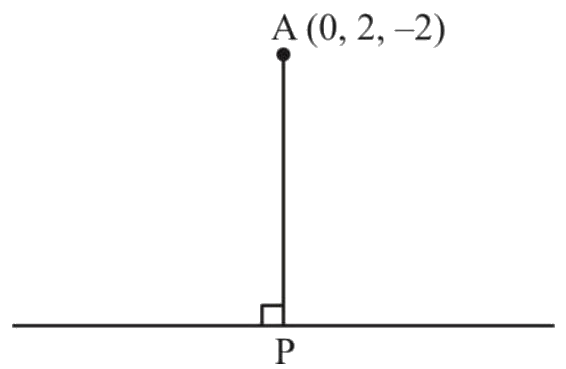
The distance of the point Q(0,2,−2) form the line passing through the point P(5,−4,3) and perpendicular to the lines r→=(−3i^+2k^)+ λ(2i^+3j^+5k^),λ∈R and r→=(i^−2j^+k^)+ μ(−i^+3j^+2k^),μ∈R is
A.
86
B.
20
C.
54
D.
74
Correct answer: D

Source solution

Sol. A vector in the direction of the required line can be obtained by cross product of |i^j^k^235−132| =−9i^−9j^+9k^ Required line, r→=(5i^−4j^+3k^)+λ′(−9i^−9j^+9k^) r→=(5i^−4j^+3k^)+λ(i^+j^−k^) Now distance of (0, 2, -2) P.V. of P≡(5+λ)i^+(λ−4)j^+(3−λ)k^ AP→=(5+λ)i^+(λ−6)j^+(5−λ)k^ AP→⋅(i^+j^−k^)=0 5+λ+λ−6−5+λ=0 λ=2 |AP→|=49+16+9 |AP→|=74Question figure
Question 279 / MCQ
Question 279
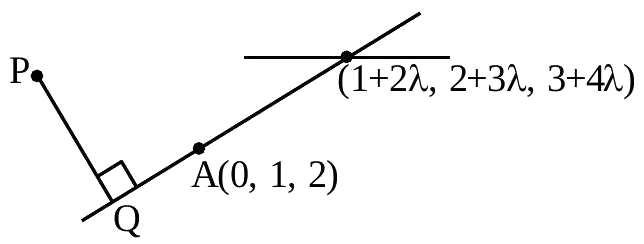
Let the line L pass through the point (0,1,2), intersect the line x−12=y−23=z−34 and be parallel to the plane 2x+y−3z=4. Then the distance of the point P(1,−9,2) from the line L is
A.
9
B.
54
C.
69
D.
74
Correct answer: D

Source solution

Sol. AB→⋅n→ ⇒[(1+2λ)i^+(1+3λ)j^+(1+4λ)k^]⋅(2i^+j^−3k^) 2+4λ+1+3λ−3−12λ=0 5λ=0⇒λ=0 Line AB→,r→=j^+2k^+μ(i^+j^+k^) General form: Q(μ,1+μ,2+μ) ∴PQ→⋅AB→=0 (μ−1)+(10+μ)+μ=0 3μ=−9⇒μ=−3 ∴ distance =16+49+9=74Question figure
Question 280 / MCQ
Question 280
The vertices B and C of a △ABC lie on the line, x+23=y−10=z4 such that BC=5 units. Then the area (in sq. units) of this triangle, given that the point A(1,−1,2), is:
A.
517
B.
34
C.
6
D.
234
Correct answer: B

Source solution

Area of △ABC=12×BC×AD. Given |BC|=5, so we need the perpendicular distance of A from the line BC. Let a point D on BC be D=(3λ−2,1,4λ). Then AD→=(3λ−3)i^+2j^+(4λ−2)k^. Also, AD→ and BC→ are perpendicular, so AD→⋅BC→=0. Hence, (3λ−3)(3)+2(0)+(4λ−2)(4)=0. 9λ−9+16λ−8=0. 25λ−17=0. λ=1725. Therefore, D=(3⋅1725−2,1,4⋅1725)=(125,1,6825). Now, |AD→|=(125−1)2+(2)2+(6825−2)2=(−2425)2+4+(1825)2=242+4(25)2+182252=576+2500+324252=3400252=103425=2345. Therefore, Area of △ABC=12×|BC|×|AD|=12×5×2345=34. Area of △ABC=34
Question 281 / MCQ
Question 281
The distance of the line x−22=y−63=z−34 from the point (1,4,0) along the line x1=y−22=z+33 is :
A.
17
B.
14
C.
15
D.
13
Correct answer: B

Source solution

Let the equation of the parallel line be x−11=y−42=z−03 The point of intersection can be expressed as (λ+1,2λ+4,3λ) We also have the parametric representation of another line: (2t+2,3t+6,4t+3) Setting the two expressions equal gives: λ+1=2t+2 2λ+4=3t+6 3λ=4t+3 From the first equation, we can express λ in terms of t: λ=2t+1 Substituting λ into the second equation: 2(2t+1)+4=3t+6 This simplifies to: 4t+2+4=3t+6 Thus, 4t+6=3t+6 Solving for t: t=0 Now substituting t=0 back into the parametric equations gives the point of intersection: (2(0)+2,3(0)+6,4(0)+3)=(2,6,3) Next, we calculate the distance from the point (1,4,0) to the point of intersection (2,6,3): Distance=(2−1)2+(6−4)2+(3−0)2 Calculating each term: =12+22+32=1+4+9=14 Thus, the final answer is 14
Question 282 / MCQ
Question 282
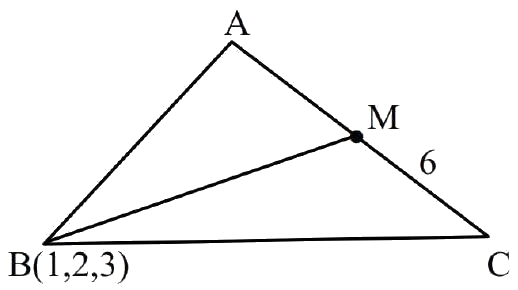
Let in a △ABC, the length of the side AC be 6, the vertex B be (1,2,3) and the vertices A,C lie on the line x−63=y−72=z−7−2. Then the area (in sq. units) of △ABC is
A.
42
B.
21
C.
56
D.
17
Correct answer: B

Source solution

Let M(3λ+6,2λ+7,−2λ+7). First, we find the vector BM→: BM→=(3λ+5)i^+(2λ+5)j^+(−2λ+4)k^ Next, we compute the dot product AC→⋅BM→=0: 0=3(3λ+5)+2(2λ+5)−2(−2λ+4) We also have: BM→=2i^+3j^+6k^ Now, we calculate the magnitude of BM→: |BM→|=7 Finally, we find the area: Area=12×6×7=21 Thus, the final answer is option (2).Question figure
Question 283 / MCQ
Question 283
Let ( α,β ) be the centroid of the triangle formed by the lines 15x−y=82,6x−5y=−4 and 9x+4y=17. Then α+2β and 2α−β are the roots of the equation
A.
x2−7x+12=0
B.
x2−13x+42=0
C.
x2−14x+48=0
D.
x2−10x+25=0
Correct answer: B

Source solution

Sol. upon solving we get coordinates as (6,8),(1,2) and (5,−7) So centroid : (α,β) is α=6+1+53=4 β=8+2−73=1 α+2β=6 2α−β=7 Answer. x2−13x+42=0
Question 284 / Numerical
Question 284
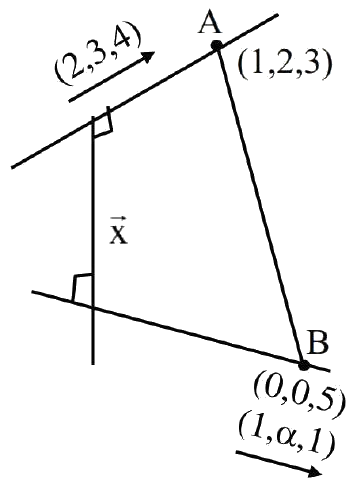
Let the point (−1,α,β) lie on the line of the shortest distance between the lines x+2−3=y−24=z−52 and x+2−1=y+62=z−10. Then (α−β)2 is equal to .
Numerical answer: ____________________
Enter the requested value (an integer; 0 decimal places). Use the units and scaling stated in the question.
Correct answer: 25

Source solution
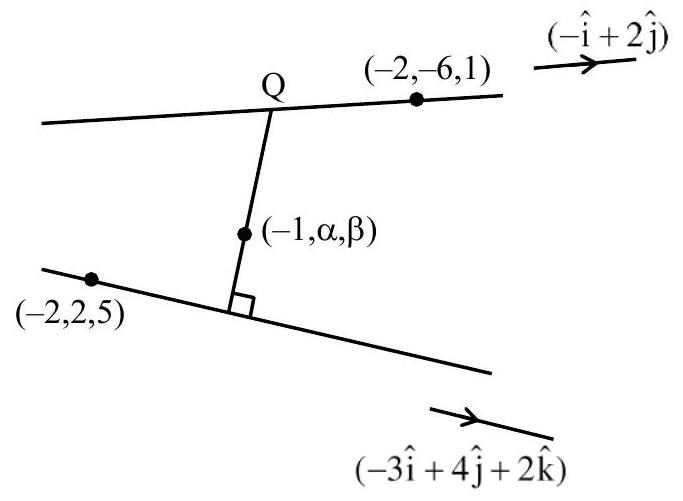
Question figure P(−3λ−2,4λ+2,2λ+5) Q(−μ−2,2μ−6,1) DRS of PQ =(3λ−μ,2μ−4λ−8,−2λ−4) DRS of PQ=|i^j^k^−120−342| =(4i^+2j^+2k^) OR (2, 1, 1) 3λ−μ2=2μ−4λ−81=−2λ−41 ⇒μ=λ+2&7λ=μ−8 λ=−1μ=1 Q:(−3,−4,1) LPQ=x+32=y+41=z−11 (−1,α,β)⇒1=α+41=β−11 ⇒α=−3,β=2 (α−β)2=25
Question 285 / MCQ
Question 285
If the shortest distance between the lines x−12=y−23=z−34 and x1=yα=z−51 is 56, then the sum of all possible values of α is
A.
32
B.
−32
C.
3
D.
-3
Correct answer: D

Source solution

Sol. L1:x−12=y−23=z−34 L1:x1=yα=z−51 x→=|i^j^k^2341α1|=i^(3−4α)−j^(−2)+k^(2α−3) S.D. =|BA→⋅n→|n→||=|(i^+2j^−2k^)⋅n→|n→|| ⇒6(13−8α)2=25((4α−3)2+(2α−3)2+16) 6(64a2−280α+169)=25(20α2−36α+34) ⇒116α2+348α−164=0 α1+α2=−348116=−3Question figure
Question 286 / MCQ
Question 286
If the lines x−11=y−22=z+31 and x−a2=y+23=z−31 intersect at the point P, then the distance of the point P from the plane z=a is :
A.
28
B.
16
C.
10
D.
22
Correct answer: A

Source solution

Sol. 1} Let x−11=y−22=z+31=λ P(λ+1,2λ+2,λ−3) & x−a2=y+23=z−31=μ P(2μ+a,3μ−2,μ+3) λ+1=2μ+a 2λ+2=3μ−2 λ−3=μ+3 22+1=2×16+a 2(μ+6)+2=3μ−2 λ=μ+6 a =23−32 2μ+12=3μ−4 a=−9 μ=16 ∴λ=22 ∴P(23,46,19) Plane is z=a z=−9 The distance of p from z=−9 is 19−(−9)=28
Question 287 / MCQ
Question 287
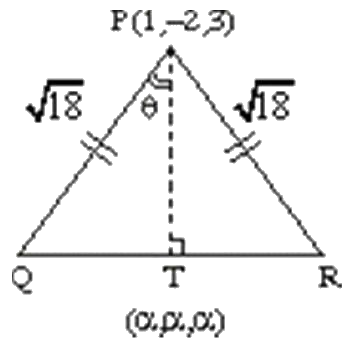
If two distinct point Q,R lie on the line of intersection of the planes −x+2y−z=0 and 3x−5y+2z=0 and PQ=PR=18 where the point P is (1,−2,3), then the area of the triangle PQR is equal to
A.
2338
B.
4338
C.
8338
D.
1523
Correct answer: B

Source solution

Sol. −x+2y−z=0 3x−5y+2z=0 n→=|i^j^k^−12−13−52| =i^(−1)−j^(1)+k^(−1) n→=−i^−j^−k^ Equation of LOI is x1=y1=z1 DR: of PT →α−1,α+2,α−3 DR : of QR→1,1,1 ⇒(α−1)×1+(α+2)×1+(α−3)×1=0 3α=2 α=23 PT2=19+649+499 PT2=1149 PT=1143 cos⁡θ=1143×132=579=19×33×3 =1933 cos⁡2θ=2×1927−1=1127 sin⁡2θ=1−(1127)2=381627 =42738 Area =12×1818×42738 =182×42738=362738=4338Question figure
Question 288 / MCQ
Question 288
Let in a △ABC, the length of the side AC be 6 , the vertex B be (1,2,3) and the vertices A,C lie on the line x−63=y−72=z−7−2. Then the area (in sq. units) of △ABC is
A.
42
B.
21
C.
56
D.
17
Correct answer: B

Source solution

Sol. Let M(3λ+6,2λ+7,−2λ+7) BM→=(3λ+5)i^+(2λ+5)j^+(−2λ+4)k^ AC→⋅BM→=0=3(3λ+5)+2(2λ+5)−2(−2λ+4) BM→=2i^+3j^+6k^ |BM→|=7 Area =12×6×7=21 Option (2) is the correct answer.
Question 289 / Numerical
Question 289
If the line, 2x−y+3=0 is at a distance 15 and 25 from the lines 4x−2y+α=0 and 6x−3y+β=0, respectively, then the sum of all possible values of α and β is
Numerical answer: ____________________
Enter the requested value (an integer; 0 decimal places). Use the units and scaling stated in the question.
Correct answer: 30

Source solution

30 L1:2x−y+3=0  L2:4x−2y+α=0  L3:6x−3y+β=0 |α2−3|5=15⇒α2−3=1,−1⇒α=8,4 |β3−3|5=25⇒β3−3=2,−2⇒β=15,3
Question 290 / Numerical
Question 290
The shortest distance between the lines x−23=y+12=z−62 and x−63=1−y2=z+80 is ______.
Numerical answer: ____________________
Enter the requested value (an integer; 0 decimal places). Use the units and scaling stated in the question.
Correct answer: 14

Source solution

The direction vectors are (3,2,2) and (3,−2,0). Their cross product is (4,6,−12), of magnitude 14. The scalar triple product with displacement (4,2,−14) is 196, so the shortest distance is 14.
Question 291 / MCQ
Question 291
Let two vertices of triangle ABC be (2,4,6) and (0,−2,−5), and its centroid be (2,1,−1). If the image of third vertex in the plane x+2y+4z=11 is (α,β,γ), then αβ+βγ+γα is equal to
A.
72
B.
74
C.
76
D.
70
Correct answer: B

Source solution

Given points A(2,4,6), B(0,−2,−5), and G(2,1,−1), we need to find the coordinates of vertex C(x,y,z). 1. **Finding x**: 2+0+x3=2⇒2+0+x=6⇒x=4 2. **Finding y**: 4−2+y3=1⇒4−2+y=3⇒y=1 3. **Finding z**: 6−5+z3=−1⇒6−5+z=−3⇒z=−4 Thus, the coordinates of vertex C are C(4,1,−4). Next, we find the image of vertex C in the plane, denoted as (α,β,γ): α−41=β−12=γ+44=−2(4+2−16−11)21 Calculating the right-hand side: 4+2−16−11=−21⇒−2(−21)=42⇒4221=2 Now, we have: α−41=2⇒α=6 β−12=2⇒β−1=4⇒β=5 γ+44=2⇒γ+4=8⇒γ=4 Thus, the image coordinates are (α,β,γ)=(6,5,4). Finally, we calculate: αβ+βγ+γα=6⋅5+5⋅4+4⋅6=30+20+24=74 The final answer is: αβ+βγ+γα=74
Choose another chapter