Learne2i
Learne2i Priority Practice solutions
JEE Main 2026 / Session 2
All chapters

Mathematics

Three Dimensional Geometry

Question 246 / MCQ
Question 246
The plane passing through the point (4,−1,2) and parallel to the lines x+23=y−2−1=z+12 and x−21=y−32=z−43 also passes through the point:
A.
(−1,−1,−1)
B.
(−1,−1,1)
C.
(1,1,−1)
D.
(1,1,1)
Correct answer: C

Source solution

Sol. Let n→ be the normal vector to the plane passing through the point (4,−1,2) and parallel to the lines L1 and L2. We can find n→ using the determinant: n→=|i^j^k^3−12123| Calculating the determinant, we find: n→=−7i^−7j^+7k^ The equation of the plane can be expressed as: −1(x−4)−1(y+1)+1(z−2)=0 Simplifying this, we get: x+y−z−1=0 Now, we can check the options.
Question 247 / MCQ
Question 247
The perpendicular distance from the origin to the plane containing the two lines, x+23=y−25=z+57 and x−11=y−44=z+47, is:
A.
11/6
B.
611
C.
11
D.
116
Correct answer: A

Source solution

Step 1: Calculate the determinant |i^j^k^357147| Step 2: Expand the determinant =i^(5⋅7−4⋅7)−j^(3⋅7−1⋅7)+k^(3⋅4−5⋅1) =i^(35−28)−j^(21−7)+k^(12−5) =7i^−14j^+7k^ Step 3: Factor out common terms =i^−2j^+k^ Step 4: Write the equation of the plane 1(x+2)−2(y−2)+1(z+15)=0 ⇒x−2y+z+11=0 Step 5: Calculate the distance from the origin to the plane d=|11|12+(−2)2+12=111+4+1=116
Question 248 / MCQ
Question 248
The plane passing through the point (4,−1,2) and parallel to the lines x+23=y−2−1=z+12 and x−21=y−32=z−43 also passes through the point :
A.
(−1,−1,−1)
B.
(−1,−1,1)
C.
(1,1,−1)
D.
(1,1,1)
Correct answer: D

Source solution

Sol. Let n→ be the normal vector to the plane passing through (4,−1,2) and parallel to the lines L1& L2 then n→=|i^j^k^3−12123| ∴n→=−7i^−7j^+7k^ ∴ Equation of plane is −1(x−4)−1(y+1)+1(z−2)=0 ∴x+y−z−1=0
Question 249 / MCQ
Question 249
The plane through the intersection of the planes x+y+z=1 and 2x+3y−z+4=0 and parallel to y-axis also passes through the point :
A.
(−3,0,−1)
B.
(3,3,−1)
C.
(3,2,1)
D.
(−3,1,1)
Correct answer: C

Source solution

Sol. Equation of plane (x+y+z−1)+λ(2x+3y−z+4)=0⇒(1+2λ)x+(1+3λ)y+(1−λ)z−1+4λ=0 dr's of normal of the plane are 1+2λ,1+3λ,1−λ Since plane is parallel to y - axis, 1+3λ=0 ⇒λ=−1/3 So the equation of plane is x+4z−7=0 Point (3, 2, 1) satisfies this equation Hence Answer is (3)
Question 250 / MCQ
Question 250
Two lines x−31=y+13=z−6−1 and x+57=y−2−6=z−34 intersect at the point R. The reflection of R in the xy-plane has coordinates :-
A.
(2,4,7)
B.
(−2,4,7)
C.
(2,−4,−7)
D.
(2,−4,7)
Correct answer: C

Source solution

Sol. Point on L1(λ+3,3λ−1,−λ+6) Point on L2(7μ−5,−6μ+2,4μ+3) (i)⇒λ+3=7μ−5 3λ−1=−6μ+2 … (ii) ⇒λ=−1,μ=1 point R(2,−4,7) Reflection is (2,−4,−7)
Question 251 / MCQ
Question 251
The plane through the intersection of the planes x+y+z=1 and 2x+3y−z+4=0 and parallel to the y-axis also passes through the point:
A.
(−3,0,−1)
B.
(3,3,−1)
C.
(3,2,1)
D.
(−3,1,1)
Correct answer: C

Source solution

Sol. Equation of the plane: Starting with the equation: (x+y+z−1)+λ(2x+3y−z+4)=0 we can rearrange it to: (1+2λ)x+(1+3λ)y+(1−λ)z−(1−4λ)=0 The direction ratios (dr's) of the normal to the plane are: 1+2λ,1+3λ,1−λ Since the plane is parallel to the y-axis, we set: 1+3λ=0 Solving for λ: λ=−13 Substituting λ back into the equation of the plane gives: x+4z−7=0 To verify, we check if the point (3,2,1) satisfies this equation: 3+4(1)−7=0 Thus, the point satisfies the equation. Hence, the answer is 3.
Question 252 / MCQ
Question 252
the perpendicular distance from the origin to the plane containing the two lines, x+23=y−25=z+57 and x−11=y−44=z+47, is:
A.
11/6
B.
611
C.
11
D.
116
Correct answer: A

Source solution

Sol. |ijk357147| i^(35−28)−j^(21.7)+k^(12−5) 7i^−14j^+7k^ i^−2j^+k^ 1(x+2)−2(y−2)+1(z+15)=0 x−2y+z+11=0 114+1+1=116
Question 253 / MCQ
Question 253
Two lines x−31=y+13=z−6−1 and x+57=y−2−6=z−34 intersect at the point R. The reflection of R in the xy-plane has coordinates :-
A.
(2,4,7)
B.
(−2,4,7)
C.
(2,−4,−7)
D.
(2,−4,7)
Correct answer: C

Source solution

Sol. Consider the points on the lines: L1(λ+3,3λ−1,−λ+6) L2(7μ−5,−6μ+2,4μ+3) Setting the coordinates equal gives us the following equations: 1. λ+3=7μ−5 \tag{i} 2. 3λ−1=−6μ+2 \tag{ii} From equation (i), we can express λ in terms of μ: λ=7μ−8 Substituting this into equation (ii): 3(7μ−8)−1=−6μ+2 Simplifying: 21μ−24−1=−6μ+2 21μ+6μ=27 27μ=27⟹μ=1 Now substituting μ=1 back to find λ: λ=7(1)−8=−1 Thus, the point R is: R(2,−4,7) The reflection of point R is: (2,−4,−7)
Question 254 / MCQ
Question 254
The shortest distance between lines L1 and L2, where L1:x−12=y+1−3=z+42 and L2 is the line passing through the points A(−4,4,3)⋅B(−1,6,3) and perpendicular to the line x−3−2=y3=z−11, is
A.
121221
B.
24117
C.
141221
D.
42117
Correct answer: C

Source solution

Sol.- L2=x+43=y−42=z−30 ∴ S.D =|x2−x1y2−y1z2−z12−32320||n1→×n2→| =|5−5−72−32320||n1→×n2→| =141|−4i^+6j^+13k^| =14116+36+169 =141221
Question 255 / MCQ
Question 255
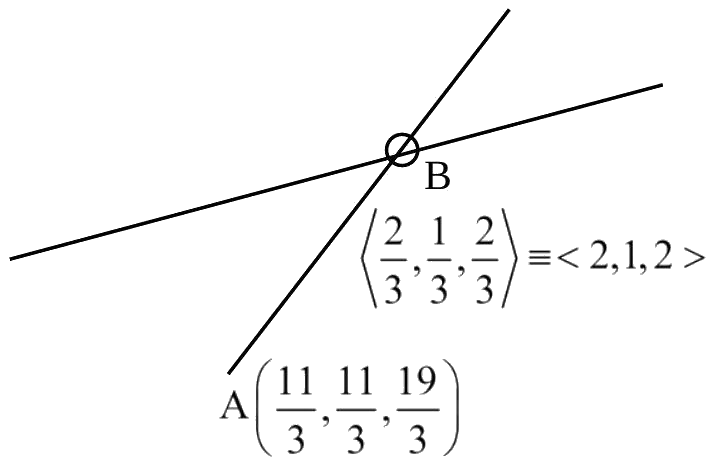
Consider the line L passing through the points (1,2,3) and (2,3,5). The distance of the point (113,113,193) from the line L along the line 3x−112=3y−111=3z−192 is equal to :
A.
3
B.
5
C.
4
D.
6
Correct answer: A

Source solution

Sol. Given the equations: x−12−1=y−23−2=z−35−3 This simplifies to: x−11=y−21=z−32=λ From this, we can express x, y, and z in terms of λ: x=1+λ,y=2+λ,z=3+2λ The point B can be represented as: B(1+λ,2+λ,3+2λ) The direction ratios (D.R.) of line segment AB are given by: ⟨3λ−83,3λ−53,6λ−103⟩ Substituting B into the equation: B(53,83,133) Setting the ratios equal: 3λ−83λ−5=21 Cross-multiplying gives: 3λ−8=6λ−10 Rearranging the equation: 3λ=2⇒λ=23 Now, we calculate the length of AB: AB=36+9+363=93=3Question figure
Question 256 / MCQ
Question 256
The line L1 is parallel to the vector a→=−3i^+2j^+4k^ and passes through the point (7,6,2) and the line L2 is parallel to the vector b→=2i^+j^+3k^ and passes through the point (5,3,4). The shortest distance between the lines L1 and L2 is :
A.
2338
B.
2157
C.
2357
D.
2138
Correct answer: A

Source solution

Sol. Given the lines: L1:(7i^+6j^+2k)+λ(−3i^+2j^+4k) L2:(5i^+3j^+4k)+μ(2i^+j^+3k) To find the distance between the skew lines, we use the formula: Distance=(a2−a1)⋅(b1×b2)‖b1×b2‖ Where: - a1=(7,6,2) - a2=(5,3,4) - b1=(−3,2,4) - b2=(2,1,3) Calculating a2−a1: a2−a1=(5−7,3−6,4−2)=(−2,−3,2) Next, we compute b1×b2: b1×b2=|i^j^k^−324213|=i^(2⋅3−4⋅1)−j^(−3⋅3−4⋅2)+k^(−3⋅1−2⋅2) Calculating the determinant: =i^(6−4)−j^(−9−8)+k^(−3−4) =2i^+17j^−7k^ Now, we find the magnitude ‖b1×b2‖: ‖b1×b2‖=22+172+(−7)2=4+289+49=342 Now substituting into the distance formula: Distance=(−2,−3,2)⋅(2,17,−7)342 Calculating the dot product: =(−2⋅2)+(−3⋅17)+(2⋅−7)342=−4−51−14342=−69342 Thus, the distance is: =69342=69338=2338 Final answer: 2338
Question 257 / MCQ
Question 257
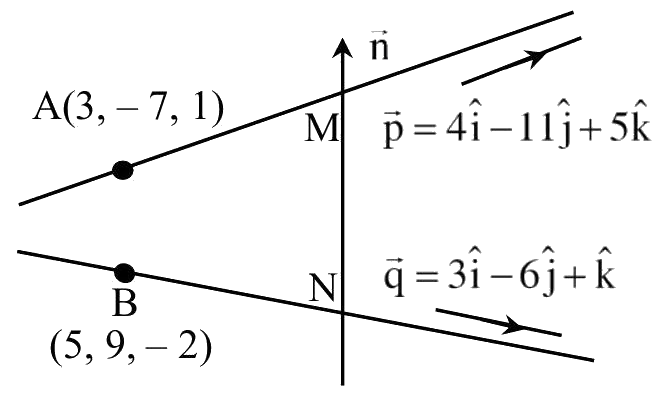
The shortest distance between the line x−34=y+7−11=z−15 and x−53=y−9−6=z+21 is :
A.
187563
B.
178563
C.
185563
D.
179563
Correct answer: A

Source solution

Sol. n→=p→×q→ n→=|i^j^k^4−1153−61|=19i^+11j^+9k^ S.d. = projection of AB→ on n→ =|AB→⋅n→|n→||=|(2i^+16j^−3k^)⋅(19i^+11j^+9k^)361+121+81| =38+176−27563 S.d. =187563Question figure
Question 258 / MCQ
Question 258
The line l1 passes through the point (2,6,2) and is perpendicular to the plane 2x+y−2z=10. Then the shortest distance between the line l1 and the line x+12=y+4−3=z2 is :
A.
133
B.
193
C.
7
D.
9
Correct answer: A

Source solution

Sol. 9} equation of l1 is x−22=y−61=z−2−2 Let l2 is x+12=y+4−3=z2 Point on l1 is a =(2,6,2), direction p→=⟨2,1,−2⟩ Point on l2 is b=(−1,−4,0) direction q→=⟨2,−3,2⟩ Shortest distance between l1 and l2=|(a→−b→)⋅(p→×q→)|p→×q→|| ∵p→×q→=|i^j^k21−22−32|=i^(−4)−j^(8)+k(−8)=|⟨3,10,2⟩⋅⟨−4,−8,−8⟩16+64+64|=|−12−80−16144|=10812=9 Shortest distance between the lines is 9 .
Question 259 / MCQ
Question 259
Consider the line L passing through the points (1,2,3) and (2,3,5). The distance of the point (113,113,193) from the line L along the line 3x−112=3y−111=3z−192 is equal to :
A.
3
B.
5
C.
4
D.
6
Correct answer: A

Source solution

Sol. x−12−1=y−23−2=z−35−3 ⇒x−11=y−21=z−32=λ B(1+λ,2+λ,3+2λ) D.R. of AB=<3λ−83,3λ−53,6λ−103> B (53,83,133)3λ−83λ−5=21⇒3λ−8=6λ−10 3λ=2 λ=23 AB=36+9+363=93=3Question figure
Question 260 / MCQ
Question 260
Let P the point of intersection of the lines x−21=y−45=z−21 and x−32=y−23=z−32. Then, the shortest distance of P from the line 4x=2y=z is
A.
5147
B.
147
C.
3147
D.
6147
Correct answer: C

Source solution

Line L1:x−21=y−45=z−21=λ Hence, x=2+λ,y=4+5λ,z=2+λ. Similarly, Line L2:x−32=y−23=z−32=μ gives x=3+2μ,y=2+3μ,z=3+2μ. Since the two lines intersect at P, 2+λ=3+2μ, 4+5λ=2+3μ. From the first equation, λ−2μ=1. From the second, 5λ−3μ=−2. Substituting λ=1+2μ, 5(1+2μ)−3μ=−2 5+7μ=−2 μ=−1. Therefore, λ=1+2(−1)=−1. Hence, P=(2−1,4−5,2−1)=(1,−1,1). --- The line 4x=2y=z can be written as x1=y2=z4=t. Thus it passes through the origin and has direction vector d→=(1,2,4). Let r→=(1,−1,1) be the position vector of P. The shortest distance from a point to a line through the origin is D=|r→×d→||d→|. Now, r→×d→=|i^j^k^1−11124|=(−6,−3,3). Therefore, |r→×d→|=(−6)2+(−3)2+32=54=36. Also, |d→|=12+22+42=21. Hence, D=3621=327=3147. 3147 Hence, the correct option is (3) 3147.
Choose another chapter