Learne2i
Learne2i Priority Practice solutions
JEE Main 2026 / Session 2
All chapters

Mathematics

Three Dimensional Geometry

Question 261 / MCQ
Question 261
The line L1 is parallel to the vector a→=−3i^+2j^+4k^ and passes through the point (7,6,2) and the line L2 is parallel to the vector b→=2i^+j^+3k^ and passes through the point (5, 3, 4). The shortest distance between the lines L1 and L2 is :
A.
2338
B.
2157
C.
2357
D.
2138
Correct answer: A

Source solution

Sol. L1:(7i^+6j^+2k)+λ(−3i^+2j^+4k) L2:(5i^+3j^+4k)+λ(2i^+j^+3k) Distance between skew lines =(2i^+3j^−2k^)⋅(2i^+17j^−7k^)342 =69342=69338=2338
Question 262 / MCQ
Question 262
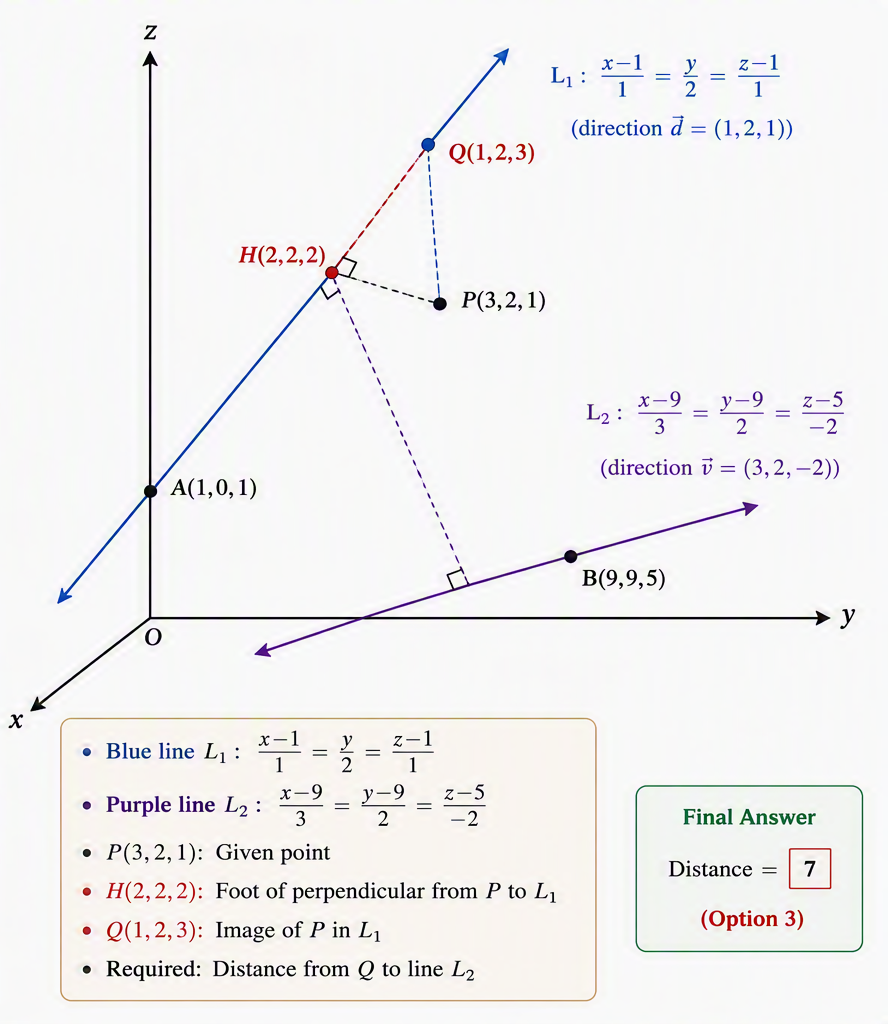
Let Q(a,b,c) be the image of the point P(3,2,1) in the line x−11=y2=z−11. Then the distance of Q from the line x−93=y−92=z−5−2 is
A.
6
B.
8
C.
7
D.
5
Correct answer: C

Source solution

Given:P=(3,2,1),L1:x−11=y2=z−11. A point on L1 isA=(1,0,1),and its direction vector isd→=(1,2,1). Let H be the foot of the perpendicularfrom P to L1.H=A+λd→. λ=(P−A)⋅d→d→⋅d→. P−A=(3,2,1)−(1,0,1)P−A=(2,2,0). λ=(2,2,0)⋅(1,2,1)12+22+12=2+46=1. H=(1,0,1)+(1,2,1)=(2,2,2). Since Q is the image of P in L1,H is the midpoint of PQ. Q=2H−P=2(2,2,2)−(3,2,1)=(4,4,4)−(3,2,1)=(1,2,3). Q=(1,2,3) Now consider the second lineL2:x−93=y−92=z−5−2. A point on L2 isB=(9,9,5),and its direction vector isv→=(3,2,−2). BQ→=Q−B=(1,2,3)−(9,9,5)=(−8,−7,−2). Distance of Q from L2=‖BQ→×v→‖‖v→‖. BQ→×v→=|i^j^k^−8−7−232−2|=(18,−22,5). ‖BQ→×v→‖=182+(−22)2+52=324+484+25=833=717. ‖v→‖=32+22+(−2)2=17. ∴ dist(Q,L2)=71717=7. dist(Q,L2)=7 Option 3 Question figure
Question 263 / MCQ
Question 263
Let L be the line x+12=y+13=z+36 and let S be the set of all points (a, b, c) on L, whose distance from the line x+12=y+13=z−90 along the line L is 7. Then ∑(a,b,c)∈S(a+b+c) is equal to :
A.
34
B.
28
C.
40
D.
6
Correct answer: A

Source solution

M is the point of intersection of L1 & L2 ⇒2λ−1=2μ−1,3λ−1=3μ−1,6λ−3=9⇒λ=2=μ⇒M(3,5,9) Now let point P be ( 2 K−1,3 K−1,6 K−3 ) on L2 such that PM=7 ⇒(2 K−4)2+(3 K−6)2+(6 K−12)2=7⇒49 K2+196−196 K=49⇒ K2+4−4 K=1⇒ K2−4 K+3=0⇒ K=1,3 So points P & Q are (1, 2, 3) & (5, 8, 15) So sum of all co-ordinates of P&Q=34
Question 264 / MCQ
Question 264
If the foot of the perpendicular from point (4,3,8) on the line L1:x−al=y−23=z−b4, l≠0 is (3,5,7), then the shortest distance between the line L1 and line L2:x−23=y−44=z−55 is equal to :
A.
12
B.
16
C.
23
D.
13 Official Answer by NTA (2)}
Correct answer: B

Source solution

Sol. (3,5,7) satisfy the line L1 3−aℓ=5−23=7−b4 3−aℓ=1&7−b4=1 (2)a+ℓ=3…(1)&b=3 v→1=⟨4,3,8⟩−⟨3,5,7⟩ v→1=⟨1,−2,1⟩ v→2=⟨ℓ,3,4⟩ v→1⋅v→2=0⇒ℓ−6+4=0⇒ℓ=2 a+ℓ=3⇒a=1 L1:x−12=y−23=z−34 L2:x−23=y−44=z−55 A=<1,2,3> B=<2,4,5> AB→=⟨1,2,2⟩ p→=2i^+3j^+4k^ q→=3i^+4j^+5k^ p→×q→=−i^+2j^−k^ Shortest distance =|AB→⋅(p→×q→)|p→×q→||=16
Question 265 / MCQ
Question 265
Let d be the distance of the point of intersection of the lines x+63=y2=z+11 and x−74=y−93=z−42 from the point (7,8,9). Then d2+6 is equal to :
A.
(4) 78
B.
(3) 75
C.
(2) 69
D.
(1) 72
Correct answer: A

Source solution

Sol. We start with the equations: x+63=y2=z+11=λ From this, we can express x, y, and z in terms of λ: x=3λ−6,y=2λ,z=λ−1 Next, we have another set of equations: x−74=y−93=z−42=μ This gives us: x=4μ+7,y=3μ+9,z=2μ+4 Now, we equate the expressions for x: (1)3λ−6=4μ+7⇒3λ−4μ=13 Next, we equate the expressions for y: (2)2λ=3μ+9⇒2λ−3μ=9 We can multiply the second equation by 3: (3)6λ−9μ=27 Now, we multiply the first equation by 2: (4)6λ−8μ=26 Next, we subtract equation (4) from equation (3): (6λ−9μ)−(6λ−8μ)=27−26 This simplifies to: −μ=−1⇒μ=−1 Substituting μ=−1 back into equation (1): 3λ−4(−1)=13 This simplifies to: 3λ+4=13⇒3λ=9⇒λ=3 Now we can find the coordinates: x=3λ−6=3(3)−6=3 y=2λ=2(3)=6 z=λ−1=3−1=2 Thus, the intersection point is (3,6,2). Next, we find the distance d2 from the point (3,6,2) to the point (7,8,9): d2=(7−3)2+(8−6)2+(9−2)2=42+22+72=16+4+49=69
Question 266 / MCQ
Question 266
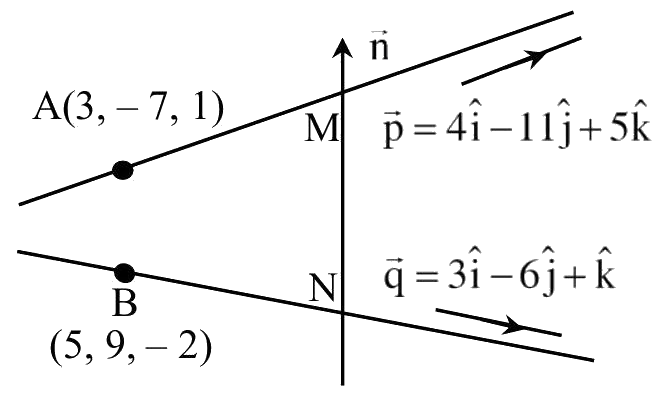
The shortest distance between the line x−34=y+7−11=z−15 and x−53=y−9−6=z+21 is :
A.
187563
B.
178563
C.
185563
D.
179563
Correct answer: A

Source solution

n→=p→×q→ Calculating the cross product: n→=|i^j^k^4−1153−61|=19i^+11j^+9k^ Next, we find the shortest distance (S.d.) as the projection of AB→ on n→: S.d.=|AB→⋅n→|n→|| Calculating the dot product: AB→=2i^+16j^−3k^ AB→⋅n→=(2i^+16j^−3k^)⋅(19i^+11j^+9k^)=38+176−27=187 Calculating the magnitude of n→: |n→|=361+121+81=563 Thus, the shortest distance is: S.d.=|187563| Final answer: S.d.=187563Question figure
Question 267 / Numerical
Question 267
The shortest distance between the lines x−23=y+12=z−62 and x−63=1−y2=z+80 is ______.
Numerical answer: ____________________
Enter the requested value (an integer; 0 decimal places). Use the units and scaling stated in the question.
Correct answer: 14

Source solution

The direction vectors are (3,2,2) and (3,−2,0). Their cross product is (4,6,−12), of magnitude 14. The scalar triple product with displacement (4,2,−14) is 196, so the shortest distance is 14.
Question 268 / MCQ
Question 268
The shortest distance between the lines x−12=y−21=z−6−3 and x−12=y+8−7=z−45
A.
53
B.
23
C.
33
D.
43
Correct answer: B

Source solution

Sol. 4 L1=x−12=y+8−7=z−45=λ L2x−12=y−21=z−6−3=μ S.D. =|(b→−a→)⋅(b→1×b→2)|b→1×b→2||a→=i−8j+4kb→=i+2j+6k b→1×b→2=|ijk2−7521−3| =i(21−5)−j(−6−10)+k(2+14) =16i+16j+16k |b→1×b→2|=|16(i+j+k)| =16×3 b→−a→=(10j+2k) S.D. =|(10j+2k)⋅16(i+j+k)163| =|16(10+2)163|=123⇒123×33 =1233=43
Question 269 / MCQ
Question 269
Shortest distance between the lines x−31=y−84=z−322,x+31=y+71=z−67 is
A.
330
B.
30
C.
230
D.
430
Correct answer: A

Source solution

Sol. AB→=−3ı^−7ȷ^+6k^−(3ı^+8ȷ^+3k^)=−6ı^−15ȷ^+3k^ p→=ı^+4ȷ^+22k^ q→=ı^+ȷ^+7k^ p→×q→=|ı^ȷ^k^1422117|=6ı^+15ȷ^−3k^ Shortest distance =|AB→⋅(p→×q→)||p→×q→|=|36+225+9|36+225+9=330.
Question 270 / Numerical
Question 270
If the shortest distance between the line joining the points (1,2,3) and (2,3,4), and the line x−12=y+1−1=z−20 is a, then 28a2 is equal to
Numerical answer: ____________________
Enter the requested value (an integer; 0 decimal places). Use the units and scaling stated in the question.
Correct answer: 18

Source solution

18 A (1, 2, 3) B (2,3,4) Equation of line AB x−11=y−21=z−31 Given line x−12=y+1−1=z−20 shortest distance =|(a→2−a→1)⋅(b→2×b→1)|b→1×b→2|| =|(3j^−k^)⋅(i^+2j^−3k^)1+4+9| α=314 28α2=28×914=18
Question 271 / MCQ
Question 271
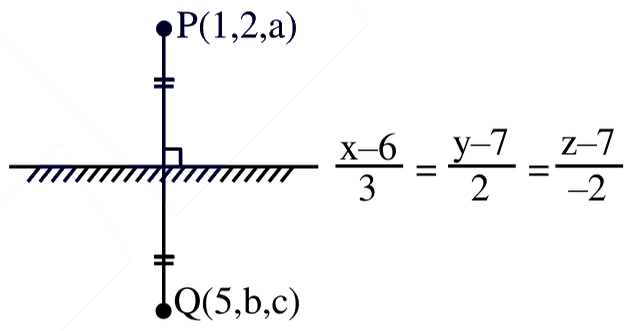
If the image of the point P(1,2,a) in the line x−63=y−72=7−z2 is Q(5, b,c), then a2+b2+ c2 is equal to
A.
293
B.
264
C.
298
D.
283
Correct answer: C

Source solution

Point M≡(3, b2+1,c+a2) satisfies the line 3−63=b2+1−72=c+a2−7−2−1=b−124=c+a−14−4 ⇒b=8…(1)&c+a=18 Now PQ⊥L ⇒(4i+(b−2)j+(c−a)k)⋅(3i+2j−2k)=0⇒12+2( b−2)−2(c−a)=0⇒6+(b−2)−(c−a)=0⇒ b−c+a+4=0⇒8−c+a+4=0⇒c+a=12 From (2) & (3) c=15&a=3 So a2+b2+c2=9+64+225=298 Question figure
Question 272 / MCQ
Question 272
The shortest distance between the lines x−32=y+15−7=z−95 and x+12=y−11=z−9−3 is
A.
63
B.
43
C.
53
D.
83
Correct answer: B

Source solution

Sol. x−32=y+15−7=z−95&x+12=y−11=z−9−3 S.D =|(a¯2⋅a¯1)⋅(b¯1⋅b¯2)||b¯1×b¯2| a1=3,−15,9 b1=2,−7,5 a2=−1,1,9 b2=2,1,−3 a2−a1=−4,16,0 b―1×b―2=|i^j^k^2−7521−3|=i^(16)−j^(−16)+k^(16) 16(i^+j^+k^) |b―1×b―2|=163 ∴(a―2−a―1)⋅(b―1−b―2)=16[−4+16]=(16)(12) S.D. =(16)(12)163=43
Question 273 / MCQ
Question 273
Let P be the point of intersection of the lines x−21=y−45=z−21 and x−32=y−23=z−32. Then, the shortest distance of P from the line 4x=2y=z is
A.
5147
B.
147
C.
3147
D.
6147
Correct answer: C

Source solution

Let L1≡x−21=y−45=z−21=λ P(λ+2,5λ+4,λ+2) L2≡x−32=y−23=z−32 P(2μ+3,3μ+2,2μ+3) Setting the equations equal: λ+2=2μ+3and3μ+2=5λ+4 From the first equation: λ=2μ+1 Substituting into the second equation: 3μ=5(2μ+1)+2 3μ=10μ+7 −7=7μ⇒μ=−1 λ=−1 Both satisfy P: P(1,−1,1) Next, consider: L3≡x1/4=y1/2=z1 L3=x1=y2=z4=k Coordinates of Q(k,2k,4k). Direction ratios of PQ=⟨k−1,2k+1,4k−1⟩. Since PQ⊥L3: (k−1)+2(2k+1)+4(4k−1)=0 k−1+4k+2+16k−4=0 21k−3=0⇒k=17 Thus, the coordinates of Q are: Q(17,27,47) Now, calculate PQ: PQ=(1−17)2+(−1−27)2+(1−47)2 =3649+8149+949=12649=1267 PQ=3147 Thus, the answer is: Option 3 will satisfy.
Question 274 / MCQ
Question 274
Let the line passing through the points, P(2,−1,2) and Q(5,3,4) meet the plane x−y+z=4 at the point R. Then the distance of the point R from the plane x+2y+3z+2=0 measured parallel to the line x−72=y+32=z−21 is equal to
A.
31
B.
189
C.
61
D.
3
Correct answer: D

Source solution

Let x−53=y−34=z−42=λ Then, R(3λ+5,4λ+3,2λ+4) ∴3λ+5−4λ−3+2λ+4=4 λ+6=4⟹λ=−2 ∴R≡(−1,−5,0) For the line: x+12=y+52=z−01=μ Point T=(2μ−1,2μ−5,μ) It lies on the plane: 2μ−1+2(2μ−5)+3μ+2=0 μ=1 ∴T=(1,−3,1) ∴RT=3
Question 275 / MCQ
Question 275
The distance of line 3y−2z−1=0=3x−z+4 from the point (2, -1, 6) is :
A.
26
B.
25
C.
26
D.
42
Correct answer: C

Source solution

3y−2z−1=0=3x−z+43y−2z−1=03x−z+4=0 D.R's ⇒(0,3,2) Let DR's of given line are a, b, c Now 3 b−2c=0 & 3a−c=0 ∴6a=3b=2ca:b:c=3:6:9 Any pt on line 3 K−1,6 K+1,9 K+1 Now 3(3 K−1)+6(6 K+1)1+9(9 K+1)=0 ⇒K=13 Point on line ⇒ (0, 3, 4) Given point (2, -1, 6) ⇒ Distance =4+16+4=26
Choose another chapter