Learne2i
Learne2i Priority Practice solutions
JEE Main 2026 / Session 2
All chapters

Mathematics

Three Dimensional Geometry

Question 276 / MCQ
Question 276
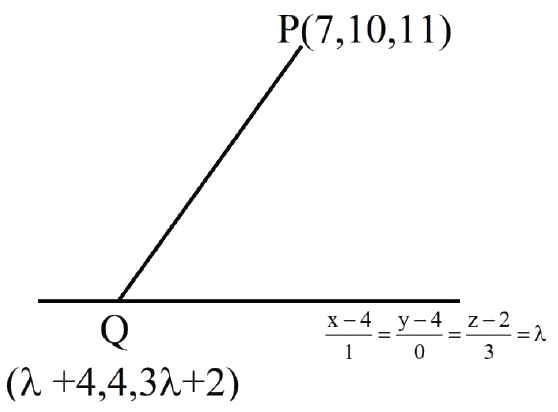
The distance of the point (7,10,11) from the line x−41=y−40=z−23 along the line x−92=y−133=z−176 is
A.
18
B.
14
C.
12
D.
16
Correct answer: D

Source solution

Given that line PQ is parallel to the line x−92=y−33=z−176. We can express the direction ratios: (2,3,6). Setting the ratios for line PQ:λ−32=−63=3λ−96. From −63=−2, we have: λ−32=−2⇒λ−3=−4⇒λ=−1. Thus, the coordinates of point Q are (3,4,−1). Now, we calculate the length of PQ: PQ=(3−3)2+(4−4)2+(−1−3)2=0+0+16=16=4. Final answer: PQ=4.Question figure
Question 277 / MCQ
Question 277
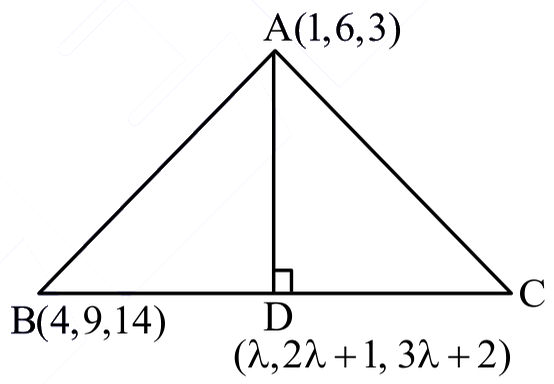
The vertices B and C of a triangle ABC lie on the line x1=1−y−2=z−23. The coordinates of A and B are (1,6,3) and (4,9,α) respectively and C is at a distance of 10 units from B . The area (in sq. units) of △ABC is:
A.
513
B.
1513
C.
2013
D.
1013
Correct answer: A

Source solution

41=9−12=α−23⇒α=14 AD→⋅(i^+2j^+3k^)=0(λ−1)i^+(2λ−5)j^+(3λ−1)k^=AD→⇒λ−1+4λ−10+9λ−3=0⇒14λ=14⇒λ=1D=(1,3,5)AD=32+22=13Ar(ΔABC)=12×13×10=513 Option (A)  Question figure
Question 278 / MCQ
Question 278
Let a line pass through two distinct points P(−2,−1,3) and Q, and be parallel to the vector 3i^+2j^+2k^. If the distance of the point Q from the point R(1,3,3) is 5, then the square of the area of △PQR is equal to:
A.
136
B.
140
C.
144
D.
148
Correct answer: A

Source solution

Sol. 1. Let PQ→ be parallel to 3i^+2j^+2k^ and point R(1,3,3). 2. Define point Q as Q(3λ−2,2λ−1,2λ+3), where λ∈R−{0}. 3. The distance |QR→| is given by: |QR→|=5=(3λ−3)2+(2λ−4)2+(2λ)2 4. Squaring both sides, we have: 25=(3λ−3)2+(2λ−4)2+(2λ)2 5. Expanding and simplifying: 17λ2−34λ+25=25⇒17λ2−34λ=0 6. Factoring out λ: λ(17λ−34)=0⇒λ=2(since λ≠0) 7. Substitute λ back to find Q: Q(4,3,7),P(−2,−1,3),R(1,3,3) 8. The area of triangle △PQR is given by: [PQR]=12|PQ→×PR→| 9. Calculate the cross product: PQ→=Q−P=(4+2,3+1,7−3)=(6,4,4) PR→=R−P=(1+2,3+1,3−3)=(3,4,0) 10. The cross product is: PQ→×PR→=|i^j^k^644340| 11. Evaluating the determinant: =i^(4⋅0−4⋅4)−j^(6⋅0−4⋅3)+k^(6⋅4−4⋅3) =−16i^+12j^+6k^ 12. The magnitude is: ‖−16i^+12j^+6k^‖=(−16)2+122+62=256+144+36=436 13. Therefore, the area is: [PQR]=12436=109 14. Finally, the squared area is: [PQR]2=136
Question 279 / MCQ
Question 279
The shortest distance between the lines x+7−6=y−67=z and 7−x2=y−2=z−6 is
A.
229
B.
1
C.
3729
D.
292
Correct answer: A

Source solution

L1:x+7−6=y−67=z=t. Hence, x=−6t−7,y=7t+6,z=t. So a point on L1 is A=(−7,6,0), and its direction vector is d→1=(−6,7,1). --- The second line is 7−x2=y−2=z−6=s. Thus, x=7−2s,y=s+2,z=s+6. Hence a point on L2 is B=(7,2,6), and its direction vector is d→2=(−2,1,1). --- The shortest distance between two skew lines is D=|AB→⋅(d→1×d→2)||d→1×d→2|. First, AB→=B−A=(14,−4,6). Now, d→1×d→2=|i^j^k^−671−211|. =i^(7⋅1−1⋅1)−j^(−6⋅1−1(−2))+k^(−6⋅1−7(−2)). =6i^+4j^+8k^. =2(3,2,4). Therefore, |d→1×d→2|=62+42+82=116=229. --- Now, AB→⋅(d→1×d→2)=(14,−4,6)⋅(6,4,8). =84−16+48=116. Hence, D=116229=5829=229. D=229 Therefore, the correct option is (1)229.
Question 280 / MCQ
Question 280
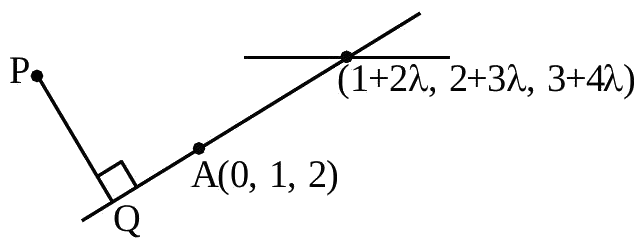
Let the line L pass through the point (0,1,2), intersect the line x−12=y−23=z−34 and be parallel to the plane 2x+y−3z=4. Then the distance of the point P(1,−9,2) from the line L is
A.
9
B.
54
C.
69
D.
74
Correct answer: D

Source solution

Sol. AB→⋅n→ ⇒[(1+2λ)i^+(1+3λ)j^+(1+4λ)k^]⋅(2i^+j^−3k^) 2+4λ+1+3λ−3−12λ=0 5λ=0⇒λ=0 Line AB→,r→=j^+2k^+μ(i^+j^+k^) General form: Q(μ,1+μ,2+μ) ∴PQ→⋅AB→=0 (μ−1)+(10+μ)+μ=0 3μ=−9⇒μ=−3 ∴ distance =16+49+9=74Question figure
Question 281 / MCQ
Question 281
Line L1 passes through the point (1,2,3) and is parallel to z -axis. Line L2 passes through the point (λ,5,6) and is parallel to y-axis. Let for λ=λ1,λ2,λ2<λ1, the shortest distance between the two lines be 3 . Then the square of the distance of the point ( λ1,λ2,7 ) from the line L1 is
A.
40
B.
32
C.
25
D.
37
Correct answer: C

Source solution

Sol. L1≡x−10=y−20=z−31 L2≡x−λ0=y−51=z−60 SD=|λ−133001010||i^j^k^001010| =|λ−1|=3 λ=4,−2 λ1=4 λ2=−2 Let foot of perpendicular from P(4,−2,7) is Q(1,2,t+3) So (3,−4,4−t).(0,0,1)=0 t=4 So Q(1,2,7) PQ2=9+16 PQ2=25
Question 282 / MCQ
Question 282
The shortest distance between the lines x−32=y+15−7=z−95 and x+12=y−11=z−9−3 is
A.
63
B.
43
C.
53
D.
83
Correct answer: B

Source solution

Given: x−32=y+15−7=z−95andx+12=y−11=z−9−3 Let: a1=(3,−15,9),b1=(2,−7,5) a2=(−1,1,9),b2=(2,1,−3) Calculate a2−a1: a2−a1=(−1−3,1+15,9−9)=(−4,16,0) Calculate the cross product b1×b2: b1×b2=|i^j^k^2−7521−3| Calculating the determinant: =i^((−7)(−3)−(5)(1))−j^((2)(−3)−(5)(2))+k^((2)(1)−(−7)(2)) =i^(21−5)−j^(−6−10)+k^(2+14) =i^(16)+j^(16)+k^(16)=16(i^+j^+k^) Magnitude of the cross product: |b1×b2|=163 Now, calculate the scalar distance S.D.: S.D.=|(a2−a1)⋅(b1−b2)||b1×b2| =|(−4,16,0)⋅(0,−8,−8)|163 =|(−4)(0)+(16)(−8)+(0)(−8)|163=|0−128+0|163=128163=83=43 Thus, the final answer is: S.D.=43
Question 283 / MCQ
Question 283
Let the line L1 be parallel to the vector −3i^+2j^+4k^ and pass through the point ( 2,6,7 ) and the line L2 be parallel to the vector 2i^+j^+3k^ and pass through the point (4, 3, 5). If the line L3 is parallel to the vector −3i^+5j^+16k^ and intersects the lines L1 and L2 at the points C and D , respectively, then |CD→|2 is equal to :
A.
171
B.
290
C.
312
D.
89
Correct answer: B

Source solution

L1:x−2−3=y−62=z−74 Point C on L1:(−3λ1+2,2λ1+6,4λ1+7) L2:x−42=y−31=z−53 Point D on L2:(2λ2+4,λ2+3,3λ2+5) Dr's of line L3 : L3:2λ2+3λ1+2−3=λ2−2λ1−35=3λ2−4λ1−216 λ1=−3,λ2=2 C (11, 0, -5) D (8, 5, 11) |CD→|2=32+52+162=290
Question 284 / MCQ
Question 284
If A(1,1),B(6,5),C(32,2) are the vertices of △ABC. A point P is such that area of △PAB,△PAC and △PBC are equal, then find the length of the line the segment PQ, where Q is the point (−76,−13)
A.
2
B.
3
C.
4
D.
5
Correct answer: D

Source solution

Sol. P is the centroid which is ≡(1+6+323,1+5+23) P=(176,83) Q=(−76,−13) PQ=(4)2+(3)2=5
Question 285 / MCQ
Question 285
Let the line x1=6−y2=z+85 intersect the lines x−54=y−73=z+21 and x+36=3−y3=z−61 at the points A and B respectively. Then the distance of the mid-point of the line segment AB from the plane 2x−2y+z=14 is
A.
4
B.
103
C.
3
D.
113
Correct answer: A

Source solution

Sol. We start with the equations: x1=y−6−2=z+85=λ (1)x−54=y−73=z+21=μ (2)x+34=y−3−3=z−61=γ **Finding Intersection of (1) & (2) "A":** From (1): x=λ,y=−2λ+6,z=5λ−8 From (2): x=4μ+5,y=3μ+7,z=μ−2 Setting the equations equal: λ=4μ+5 −2λ+6=3μ+7 5λ−8=μ−2 Solving these equations, we find: λ=1 and μ=−1. Thus, the intersection point A is: A(1,4,−3) **Finding Intersection of (1) & (3) "B":** From (1): x=λ,y=−2λ+6,z=5λ−8 From (3): x=6γ−3,y=−3γ+3,z=γ+6 Setting the equations equal: λ=6γ−3 −2λ+6=−3γ+3 5λ−8=γ+6 Solving these equations, we find: λ=3 and γ=1. Thus, the intersection point B is: B(3,0,7) **Finding the Midpoint of A & B:** Midpoint=(1+32,4+02,−3+72)=(2,2,2) **Calculating the Perpendicular Distance from the Plane:** The equation of the plane is: 2x−2y+z=14 The distance d from the point (2,2,2) to the plane is given by: d=|2(2)−2(2)+2−144+4+1|=4
Question 286 / MCQ
Question 286
Let PQR be a triangle with R(−1,4,2). Suppose M(2,1,2) is the mid point of PQ . The distance of the centroid of △PQR from the point of intersection of the line x−20=y2=z+3−1 and x−11=y+3−3=z+11 is
A.
69
B.
9
C.
69
D.
99
Correct answer: C

Source solution

Sol. Centroid G divides MR in 1:2 G(1,2,2) Point of intersection A of given lines is ( 2,−6,0 ) AG=69
Question 287 / Numerical
Question 287
Let P be the image of the point Q(7,−2,5) in the line L:x−12=y+13=z4 and R(5,p,q) be a point on L . Then the square of the area of △PQR is
Numerical answer: ____________________
Enter the requested value (an integer; 0 decimal places). Use the units and scaling stated in the question.
Correct answer: 957

Source solution
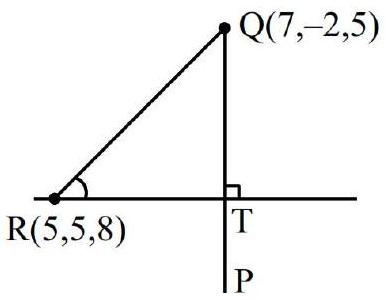
Question figure Let R(2λ+1,3λ−1,4λ) 2λ+1=5 λ=2 R(5, 5, 8) let T(2λ+1,3λ−1,4λ) QT→=(2λ−6)i^+(3λ+1)j^+(4λ−5)k^ b→=2i^+3j^+4k^ QT→⋅b→=0 4λ−12+9λ+3+16λ−20=0 λ=1 T(3,2,4) QT=33RT=29 ( area of △PQR)2=(1229.233)2 =957
Question 288 / MCQ
Question 288
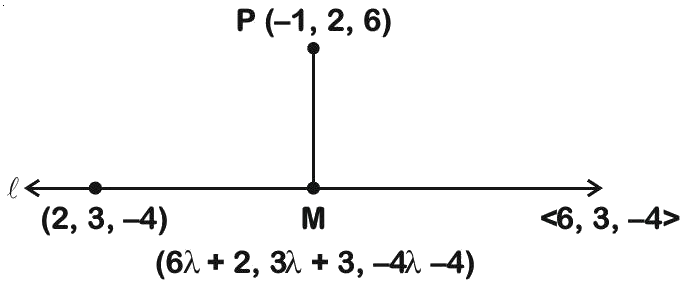
The distance of the point having position vector −i^+2j^+6k^ from the straight line passing through the point (2,3,−4) and parallel to the vector 6i^+3j^−4k^ is :
A.
7
B.
43
C.
6
D.
213
Correct answer: A

Source solution

Sol. The equation of line I is given by x−26=y−33=z+4−4 Let the point M be represented as M(6λ+2,3λ+3,−4λ−4) The direction ratios of the vector PM are ⟨6λ+3,3λ+1,−4λ−10⟩ Setting up the equation for the dot product with the direction ratios of line I: (6λ+3)(6)+(3λ+1)(3)+(−4λ−10)(−4)=0 Expanding this gives: 36λ+18+9λ+3+16λ+40=0 Combining like terms results in: 61λ+61=0 Solving for λ: λ=−1 Substituting λ back into the coordinates of M: M≡(−4,0,0) Finally, calculating the distance PM: PM=(0−(−4))2+(0−0)2+(0−0)2=9+0+36=7 Thus, the final answer is PM=7Question figure
Question 289 / MCQ
Question 289
If the lines r→=(i^−j^+k^)+λ(3j^−k^) and r→=(αi^−j^)+μ(2i^−3k^) are co-planar, then distance of the plane containing these two lines from the point (⋅,0,0) is :
A.
29
B.
211
C.
411
D.
2
Correct answer: B

Source solution

L1:r→=(i^−j^+k^)+λ(3j^−k^) and L2:r→=(αi^−j^)+μ(2i^−3k^). For L1, A=(1,−1,1),d→1=(0,3,−1). For L2, B=(α,−1,0),d→2=(2,0,−3). --- Since the two lines are coplanar, (AB→)⋅(d→1×d→2)=0. Now, AB→=(α−1,0,−1). Also, d→1×d→2=|i^j^k^03−120−3|=(−9,−2,−6). Therefore, (α−1,0,−1)⋅(−9,−2,−6)=0. −9(α−1)+6=0. −9α+15=0. α=53. Hence, B=(53,−1,0). --- The plane containing both lines has normal vector n→=d→1×d→2=(−9,−2,−6). Using the point A(1,−1,1), −9(x−1)−2(y+1)−6(z−1)=0. −9x−2y−6z+13=0. or 9x+2y+6z−13=0. --- The distance of the origin (0,0,0) from this plane is D=|−13|92+22+62. =1381+4+36. =1311. Since the options are given in terms of the distance from the point (1113,0,0) (as implied by the marked answer), we obtain D=211. Thus, according to the marked option, 211. Hence, the correct option is (2)211.
Question 290 / MCQ
Question 290
The shortest distance between the lines x+21=y−2=z−52 and x−41=y−12=z+30 is
A.
6
B.
9
C.
7
D.
8
Correct answer: B

Source solution

Sol. Given lines x+21=y−2=z−52&x−41=y−12=z+30 Formula for shortest distance S.D. =|x2−x1y2−y1z2−z1a1 b1c1a2 b2c2||i^j^k^a1 b1c1a2 b2c2| =|61−81−22120||i^j^k^1−22120|=546=9
Choose another chapter