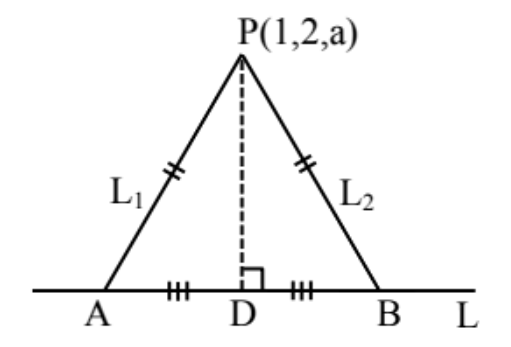
If the distances of the point (1, 2, a) from the line
along the lines
and
are equal,
then is equal to
A.
7
B.
5
C.
6
D.
4
Correct answer: A
Source solution
L :
Let
It lies on L
and
Let
It also lies on L
also
Question 292 / MCQ
Question 292
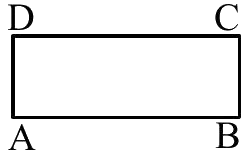
If and are the vertices of a quadrilateral ABCD, then its area is
A.
B.
C.
D.
Correct answer: A
Source solution
Given vectors:
Now, calculate the cross product .
Using the determinant formula for the cross product:
Calculating the determinant:
Simplifying each component:
Now, find the magnitude:
Finally, calculate the area:
Thus, the area is:
Question 293 / Numerical
Question 293
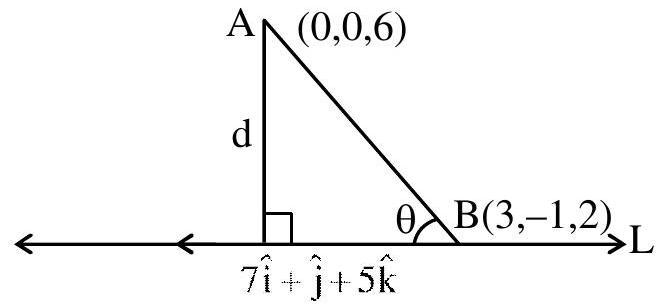
Let the line L be the projection of the line
in the plane . If d is the distance of the point from L , then is equal to
.
Numerical answer: ____________________
Enter the requested value (an integer; 0 decimal places). Use the units and scaling stated in the question.
Correct answer: 26
Source solution
for foot of of (1, 3, 4) on
So foot of
& point of intersection of with plane
is
dr's of L is
Question 294 / MCQ
Question 294
The shortest distance between the lines and is
A.
B.
2
C.
D.
3
Correct answer: B
Source solution
Sol.
We start with the equations:
Let and .
Define the vectors:
Calculate :
Next, compute the cross product :
Calculating the determinant:
This simplifies to:
Now, find the magnitude of :
Now, calculate the distance :
Substituting the values:
Calculating the dot product:
Thus, the final answer is:
Question 295 / MCQ
Question 295
Let the values of for which the shortest distance between the lines and is be and . Then the radius of the circle passing through the points and is
A.
B.
4
C.
D.
3
Correct answer: A
Source solution
Sol.
Shortest Distance
Radius of circle passing through points
Question 296 / MCQ
Question 296
The shortest distance between the lines and is
A.
B.
2
C.
D.
3
Correct answer: B
Source solution
Let the lines be
From the given equations,
and
---
The shortest distance between two skew lines is
First,
Hence,
---
Now compute :
---
Its magnitude is
---
Next,
---
Therefore,
Hence, the shortest distance between the two lines is
Question 297 / MCQ
Question 297
The distance of the line
from the point along the line
is :
A.
B.
C.
D.
Correct answer: B
Source solution
Let the equation of the parallel line be
The point of intersection can be expressed as
We also have the parametric representation of another line:
Setting the two expressions equal gives:
From the first equation, we can express in terms of :
Substituting into the second equation:
This simplifies to:
Thus,
Solving for :
Now substituting back into the parametric equations gives the point of intersection:
Next, we calculate the distance from the point to the point of intersection :
Calculating each term:
Thus, the final answer is
Question 298 / MCQ
Question 298
Let the line passing through the points and parallel to the line
intersect the line
at the point . Then the distance of from the point is :
A.
5
B.
10
C.
D.
Correct answer: D
Source solution
Question 299 / MCQ
Question 299
The distance, of the point ( ) from the line along the line , is :
A.
12
B.
14
C.
18
D.
21
Correct answer: B
Source solution
Since lies on the line
we must have
From the middle term,
Therefore,
---
Let
Then,